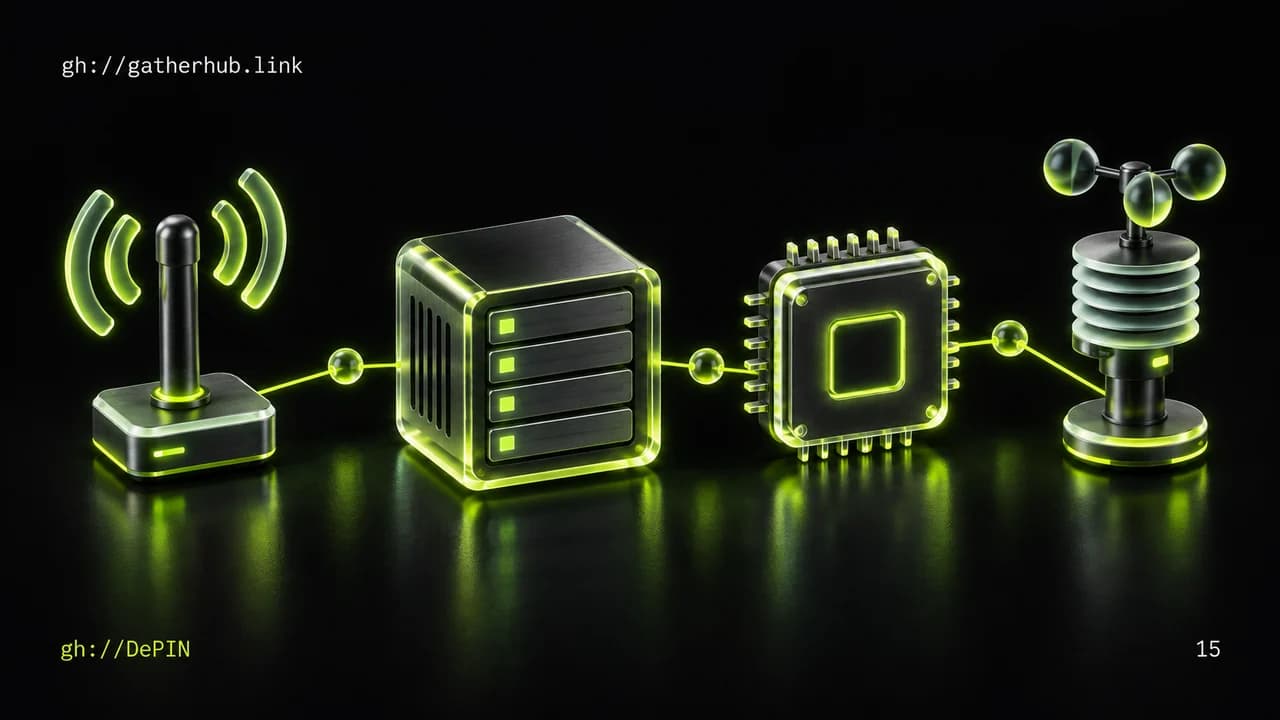
DePIN covers very different services. Renting compute is not transmitting a sensor reading; collecting street imagery is not preserving a file. Start by naming the unit of service a customer actually uses.
After defining DePIN, we can examine four categories. Named projects are documentary examples, not recommendations to buy tokens or equipment.
Transmitting data
Connectivity networks carry information between devices and services. Depending on their architecture, they may serve low-data sensors or contribute to mobile connectivity.
Helium’s documentation distinguishes its Internet of Things network from its Wi-Fi mobile offload network. Equipment intended for one use does not automatically replace equipment for another.
For a farming cooperative, a useful measure would be the proportion of readings received on time from the relevant fields. A general coverage map does not establish that experience by itself.
Storing and retrieving files
A storage service undertakes to retain data under specified conditions. Users also need to retrieve it. Advertised capacity, stored data and retrieval speed are different measures.
Filecoin describes a distributed storage system with commitments between participants. This does not mean any uploaded file will be retained forever or available instantly.
A fictional association archiving photographs could test a sample restoration, checking integrity, time and cost. The network’s disk count would provide context rather than the answer.
Providing compute
Applications need processors, memory or GPUs, components suited to some intensive calculations. Networks can connect machine providers with customers renting these resources.
Akash describes the provider and tenant relationship. Available capacity is not enough: performance, availability, location and data protection requirements also matter.
A fictional studio rendering images would compare the cost of a correctly completed job, not just an hourly machine rate. An inexpensive but unsuitable machine can cost more for the required result.
Producing field data
Other networks coordinate image or measurement collection. Hivemapper documents a mapping network supported by contributors. Data’s value depends on what it provides to a customer, including coverage, freshness and quality.
One hundred passes along the same street do not necessarily equal one hundred useful newly documented streets. Rules concerning people, locations and collected data also need examination. Distributed collection does not remove these responsibilities.
Compare outcomes
For each category, complete the sentence: “The customer pays to obtain…”. An on-time transmission, recovered file, completed computation or usable dataset provides a concrete starting point.
Compare that outcome with a conventional service, including setup, maintenance, quality and constraints. A token does not automatically make the service cheaper or more reliable.
Check your understanding
A network advertises substantial storage capacity. Does that establish fast file retrieval? No. Capacity and retrieval quality require separate assessment.
Remember: understand a DePIN through its service and unit of measurement. Different networks need different criteria.