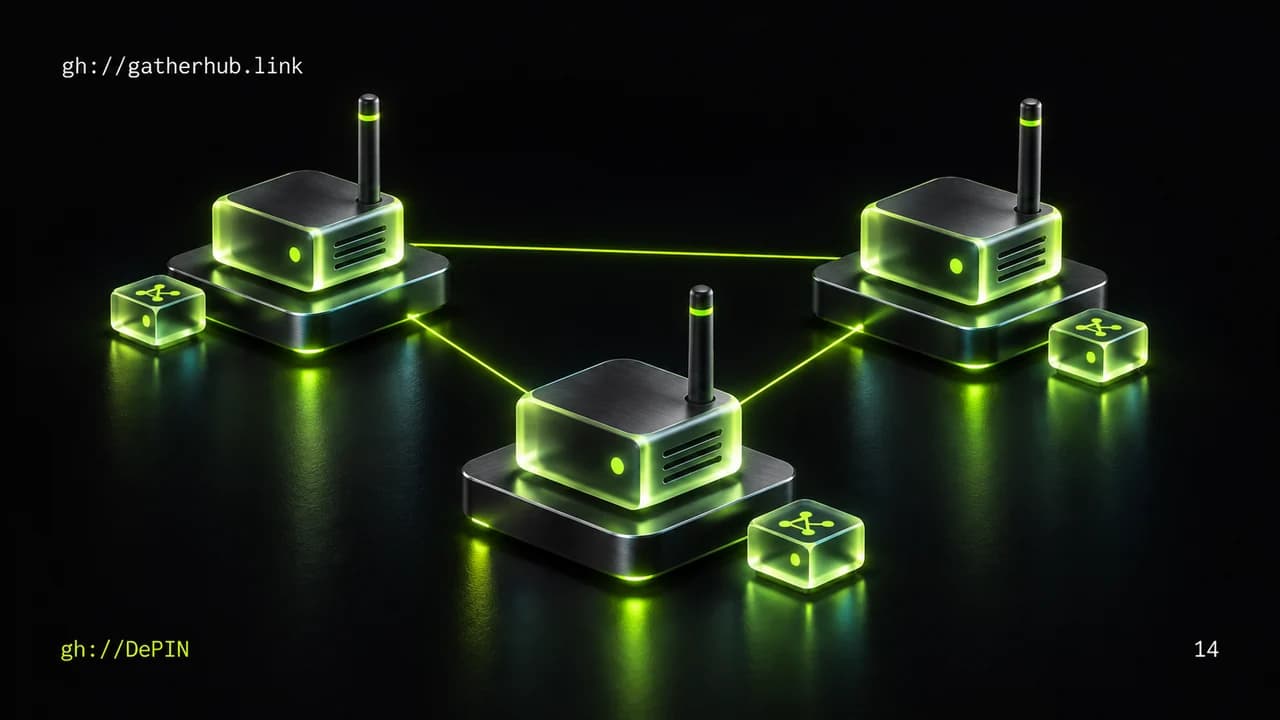
What if many participants jointly supplied connectivity, storage or useful data? That is the general idea behind DePIN, short for Decentralized Physical Infrastructure Networks.
The term groups projects coordinating distributed physical resources through blockchain mechanisms, often with token incentives. It is not a quality certification. After the Web3 foundations, this third path starts with the service rather than an asset’s price.
Start with a user’s need
Imagine a fictional farming cooperative that wants soil-moisture readings from its fields. It needs sensors, radio coverage, reliable transmission and software to read the measurements.
A network could coordinate participants installing and maintaining radio gateways. The cooperative would buy a transmission service. The first question is whether readings reliably arrive where they are needed.
The number of tokens distributed does not answer that question. The network needs to serve people who may have no interest in cryptocurrency.
Four roles in one system
Contributors supply equipment, capacity or work. Users consume a service. Verification mechanisms seek to establish which contributions qualify. Economic rules determine who pays and how participants are compensated.
These roles do not always belong to four separate businesses. A participant may hold several roles, while intermediaries can connect the network to its end customer.
Helium’s documentation provides an example of wireless networks using participant-operated gateways. Akash’s documentation describes a compute marketplace. Their mechanisms are not interchangeable.
What a blockchain can coordinate
A ledger can record equipment identities, commitments or settlement. Programs can apply payment rules using supplied information. This does not mean files, radio signals or computations all travel through the blockchain.
For our fictional cooperative, measurements would travel through communication networks. A blockchain might handle only some coordination stages. Identify which functions actually use it.
Decentralised does not mean dependency-free
A network can have many devices while depending on one manufacturer, software operator or small group able to change rewards. Distributing equipment and distributing decision-making power are different dimensions.
Machines still need maintenance and electricity, and the service has operational constraints. If a gateway fails in an isolated area, ten thousand devices elsewhere do not guarantee local continuity.
This suggests a simple method: assess useful coverage, delivered quality and replacement options instead of relying on a map filled with dots.
Check your understanding
A project has sold many devices but shows no service users. Has it demonstrated a useful network? Not yet. Devices show sold or installed capacity; the project must still establish what it delivers, to whom and with what quality.
Remember: DePIN aims to coordinate infrastructure supplied by multiple parties. Its value depends on the service delivered and how it is organised.