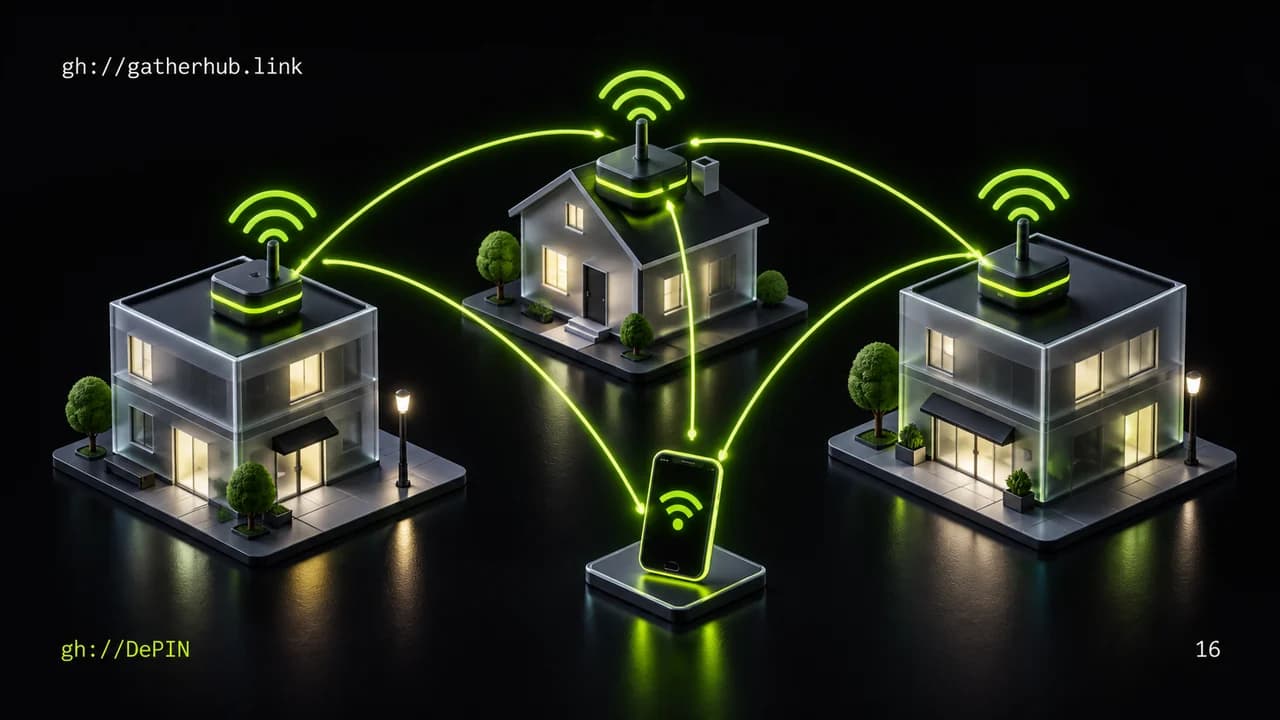
You connect a device and the dashboard marks it “active”. How does the network know it contributes anything? A DePIN must connect an advertised resource, delivered service and compensation rule.
After service categories, we can follow that chain. This is a reading model: networks do not all use the same stages or proofs.
Advertise a resource
Participants register equipment or capacity under network rules. They may install software, declare characteristics and demonstrate control of a resource.
In a fictional storage example, a provider advertises available space. This does not yet prove a customer has stored a file. Network registration, declared availability and committed service are different states.
Equipment can also be recognised without qualifying for every function. Participation conditions need separate examination from hardware compatibility.
Deliver a service outside the ledger
When customers supply data, machines store it. When users send radio messages, equipment carries them. A blockchain does not replace this physical work.
The service can then produce information needed for settlement: processed quantities, observed availability or verification results. Who generates that information, and how is it checked?
Verify a specific contribution
Proofs depend on the service. Filecoin describes Proof-of-Replication and Proof-of-Spacetime. These check storage commitments rather than certify every part of the customer experience.
Mapping imagery needs checks on data structure and usefulness. Hivemapper’s documentation points to its contribution verification rules. A counted image must still meet the intended mapping need.
Other networks use measurement services and oracles. Helium’s oracle data documentation shows how some processing and reward decisions depend on these components. Do not assume every proof is generated and checked entirely on the blockchain.
Resist artificial contributions
Imagine a fictional network paying for every measurement received. Someone could submit a thousand copies of the same measurement. Paying for them as a thousand useful observations would reward an increasing counter rather than an improving service.
Rules need to address duplicates, artificial identities and inconsistent readings. Controls may also reject honest work. Documentation should explain reasons, corrections and available appeal procedures.
Always complete the word “verified”: which property was checked, by what method and with which limits?
Settle and maintain the network
After verification, a rule calculates any compensation. Quality conditions and commitments may affect it. Participants also need to maintain equipment and follow protocol changes.
An accurately calculated reward does not prove an external customer paid. It might allocate funding intended to support launch. The next guide examines that distinction.
Check your understanding
A network proves a resource was retained. Does that show customers needed it and paid enough to fund the service? No. Technical proof and economic demand are different things to verify.
Remember: a contribution moves from advertisement to service, verification and settlement. At each stage, identify responsible parties and available evidence.