You hear about "Web3" and "blockchain" everywhere, but the technical jargon often makes it incomprehensible.
However, the idea behind Web3 is very simple: it is an approach to the internet where you can hold and transfer some digital assets using a blockchain. It is neither a complete replacement for today’s web nor a guarantee of ownership over all your data.
To understand, we just need to look at the history of the Internet in three major steps.
The History of the Internet in 3 Steps
- Web1 (The 90s - 2000s): "Read" This was the internet of static pages. You could read articles, browse directories, but you couldn't really interact. You were just a spectator.
- Web2 (2005 to today): "Read and Write" The arrival of social networks (Facebook, X, YouTube). You became an actor: you post, comment, create content. But there's a major catch: platforms control access to your account and set the service’s rules. A suspension may cut you off from your audience and content you have not backed up. That control does not mean they own everything you publish.
- Web3 (Today and tomorrow): "Read, Write, and Own" This is where Web3 comes in. The goal is to give you back control. A wallet can let you control some assets directly, without an account on a platform. However, applications, token issuers and hosting services can still impose restrictions.
How is this possible? Thanks to the blockchain.
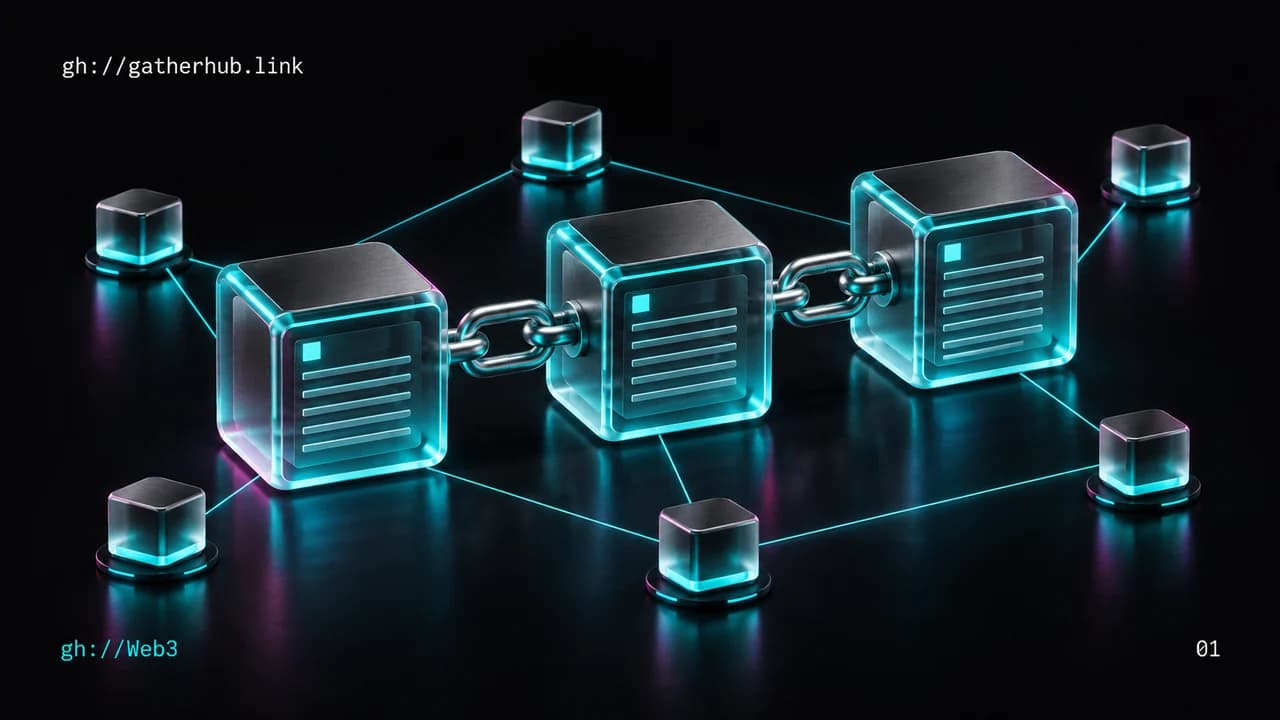
A blockchain is a shared ledger whose participants verify new entries according to common rules.
Imagine a huge accounting ledger, a large public record book. On a public blockchain, this ledger is copied across many computers. There is no central book: participants who keep a copy can check its entries.
- It is verifiable: On a public network, entries and protocol rules can be inspected. This does not prove that information entered about the outside world is true.
- Its history is difficult to change: Validation rules make arbitrary changes detectable. Security still depends on the network and its consensus mechanism.
- It can reduce reliance on an intermediary: Multiple interfaces can provide access to the same network. This does not remove possible restrictions within an application or a token.
Why is it a revolution?
Until now, on the internet, if you had "money" in a video game, or loyalty points, these things only had value because the company managing the game decided so.
A blockchain lets you check how many tokens have been issued and which addresses hold them, according to the rules of their program.
Holding a token guarantees neither its value nor a buyer nor a right to an object outside the blockchain. Transfer options also depend on the token’s rules.
How do you use it?
Some Web3 applications let you connect a wallet instead of creating a conventional account. Others still use email sign-in or an account managed by a service.
A wallet is an interface for viewing assets and authorising operations. With a self-custody wallet, you control the signing keys; with a custodial service, you rely on a third party. A single wallet is not compatible with every network.
Remember: the wallet helps you authorise an operation; the blockchain records it. Understanding what you sign matters as much as understanding the network.