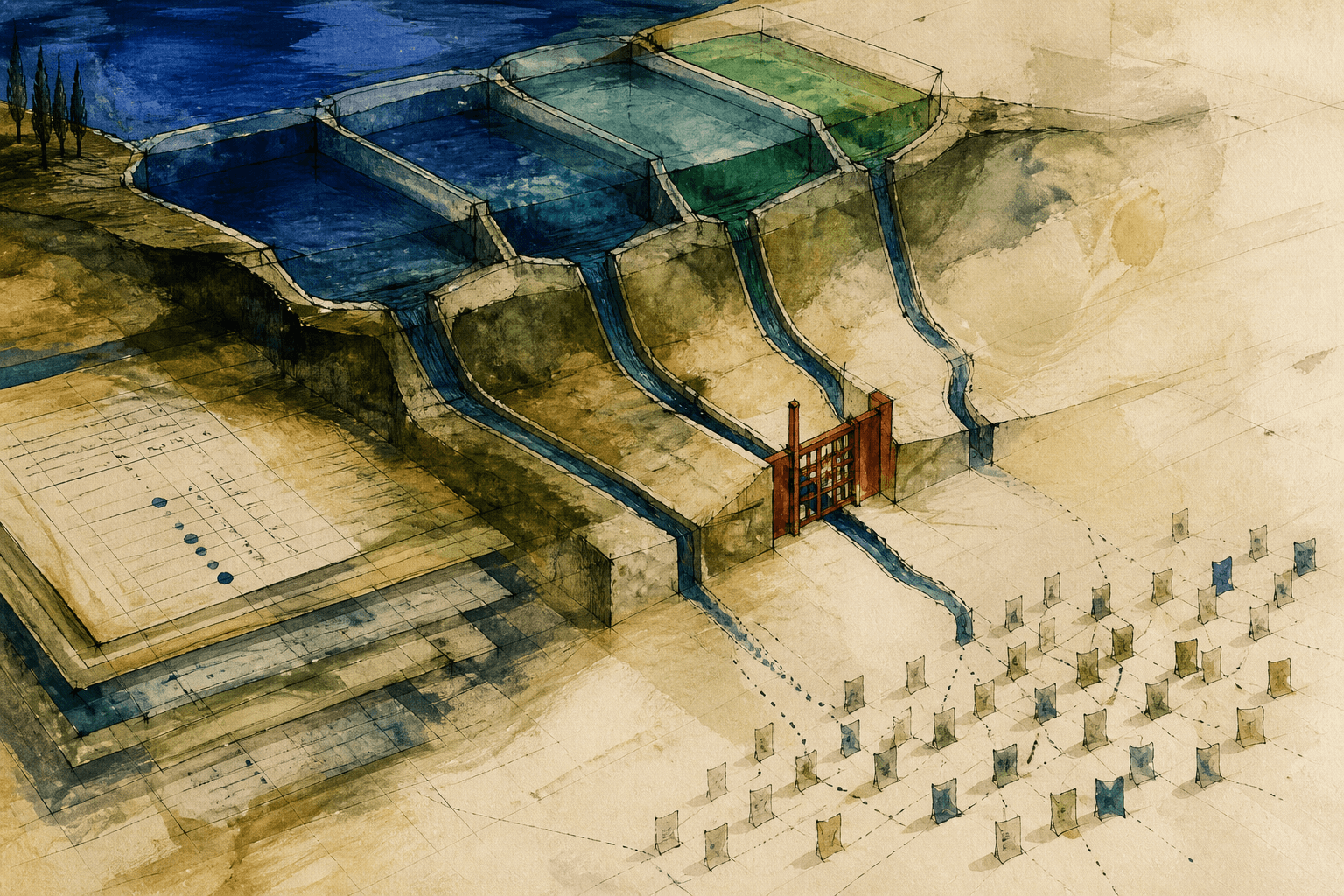
“Fully backed” may be the most reassuring phrase in the stablecoin vocabulary. It suggests a simple equation: one token in circulation, one dollar in reserve, therefore no obstacle to getting the money back. The equation is useful, but it describes only an accounting snapshot. It does not say how quickly the assets can become cash, who holds them, which token holder can claim that cash, or whether the banking and technical rails will work when many people want to exit at once.
This distinction is not theoretical. In March 2023, Circle said that $3.3 billion of the USDC reserve was deposited with Silicon Valley Bank. The amount represented roughly 8% of the reserve. After the bank closed, USDC temporarily traded below its target on secondary markets. A few days later, Circle reported that it had processed $3.8 billion of redemptions since Monday and had substantially cleared the backlog. The assets had not simply vanished. Uncertainty concerned their availability, banking timetables and the operational capacity to serve requests.
That episode provides a more precise way to examine a stablecoin. Instead of asking only “does the reserve cover the tokens?”, four separate layers should be tested: coverage, liquidity, custody and redemption. A weakness in only one layer may be enough to produce a discount, even when the published total of reserve assets remains higher than the number of tokens.
Layer one: coverage is a photograph, not a flow
A reserve is covered when the value of its assets equals or exceeds the value of tokens in circulation under a stated measurement method. The claim therefore depends on a date, a perimeter and a valuation rule. A month-end statement does not mechanically guarantee the same composition on every day of the month. Market value also does not reveal how much an issuer would receive if it had to sell a large position quickly.
Circle currently publishes the composition of the USDC reserve weekly, together with minting and burning flows, and obtains monthly third-party assurance. Its transparency page says that most of the reserve is invested in the Circle Reserve Fund, a government money market fund registered under US rule 2a-7, with the remainder held mainly as bank deposits. This is more informative than a bare “1:1” statement because readers can distinguish short-term Treasuries, overnight reverse repurchase agreements and cash.
An attestation, however, is not a general audit of the whole company. It tests defined management assertions about the reserve at defined dates. By itself, it does not certify every aspect of governance, cybersecurity, business continuity or the future treatment of every holder. The first discipline is therefore to read what a report actually covers and then identify what remains outside its scope.
The coverage test can be reduced to three questions: how many tokens form the liability, which assets enter the reserve, and at what value are the two sets compared? A table that omits one of those dimensions may look precise without demonstrating balance.
Layer two: a safe asset can be unavailable at the wrong time
Credit safety and liquidity are not synonyms. A very short-term Treasury bill normally carries low default risk, but it still has to be sold, delivered and settled. A bank deposit is denominated in dollars, but access depends on the bank, opening hours, payment systems and, in an extreme case, a resolution procedure. A reserve can be strong on paper yet difficult to mobilise for several hours or days.
European regulation explicitly recognises that difference. Delegated Regulation 2025/1264 requires relevant issuers to maintain liquidity policies, identify intraday liquidity needs, assess concentration at custodians and monitor stress conditions. Those requirements would be unnecessary if accounting coverage alone solved the problem.
For a reader, the useful comparison is not simply “cash versus securities”. It is “potential outflows versus resources that can be mobilised within the same period”. Maturities, immediately available cash, banking diversification, redemption hours and contingency arrangements matter, particularly because tokens continue trading around the clock while traditional markets and payment systems do not.
This timing mismatch explains part of the role of secondary markets. When users cannot present tokens directly to the issuer, they sell them to another participant on a platform. The price then reflects not only the estimated value of the reserve, but also the time, cost and uncertainty involved in reaching the primary redemption channel. A temporary discount can therefore appear before any permanent loss is recorded on reserve assets.
Layer three: custody determines practical access to assets
Saying that assets “back” a stablecoin does not establish who legally owns them, in which accounts they are recorded, or what happens if the issuer or an intermediary becomes insolvent. Asset segregation, custodian quality and contractual arrangements determine whether the reserve remains available to token holders rather than to other creditors.
The European MiCA regulation treats reserve composition, investment and custody as separate questions. It requires custody policies and orderly redemption plans for the relevant token categories. The Financial Stability Board follows the same functional logic: a global arrangement should make the responsibilities of issuers, custodians, technical operators and other intermediaries visible.
This prevents another shortcut. Using several banks can reduce dependence on one institution, but it also increases the number of contracts, transfers and systems that must be coordinated. Concentrating the reserve among a few providers may simplify some operations while increasing concentration risk. There is no magic number of custodians. The relevant combination is diversification, legal rights, concentration limits and replacement procedures.
Serious disclosure should identify at least the asset classes, the main types of custodian, segregation rules, control frequency and the entity that bears losses or operational costs. When those answers remain vague, a coverage percentage cannot fill the gap.
Layer four: a redemption right is not the price shown on an exchange
The final layer concerns the holder’s claim. Who can request redemption directly from the issuer? At what rate? With what fees, thresholds, delays and identity checks? A token can target one dollar on trading venues without every holder having a personal account at the issuer’s redemption window.
The New York Department of Financial Services guidance requires stablecoins under its supervision to grant lawful holders a right to timely redemption at par, subject to reasonable and clearly disclosed conditions. MiCA similarly provides a par-value redemption right for e-money tokens within its scope. These rules show why “redeemable” must be connected to a procedure and an identified claimant.
The protocol and the money must also be separated. A blockchain may transfer a token in seconds while conversion into bank money takes longer. Conversely, an issuer may be operationally ready to redeem but freeze an address to meet a legal obligation. Ledger speed does not remove compliance checks, correspondent banks or settlement windows.
The practical test is to trace the complete route of an ordinary holder: wallet, possible exchange, verified account with a partner or issuer, token burn, bank instruction and receipt of funds. Every intermediary adds conditions. A 1:1 promise does not have the same practical reach for an institution directly connected to the issuer and for an individual who can use only a secondary market.
A four-column reading grid
To avoid choosing between blind confidence and generalised suspicion, GatherHub proposes reading every reserve through a simple table.
| Question | Useful evidence | What that evidence does not guarantee | |---|---|---| | Does the reserve cover the tokens? | Dated composition, circulating tokens, valuation method, attestation | Immediate availability of assets | | Can it absorb rapid outflows? | Maturities, available cash, stress scenarios, diversified rails | Each holder’s legal claim | | Are the assets protected and accessible? | Custodians, segregation, contracts, replacement plan | Continuous operation of every process | | Can the holder obtain the promised money? | Redemption terms, timing, fees, thresholds, eligibility | A constant price on every secondary market |
This grid leads to a less dramatic but more useful conclusion. A highly liquid, properly segregated and regularly attested reserve can reduce risk substantially. It cannot eliminate risk. Stablecoin quality depends on the alignment of four mechanisms, not on one isolated percentage.
The key contribution of this distinction is temporal. Coverage answers “how much exists today?”; liquidity asks “how much can leave now?”; custody asks “who can actually mobilise the assets?”; redemption asks “who receives what, when and through which rail?”. Until all four answers are assembled, “100% reserve” is the beginning of the analysis, never its conclusion.