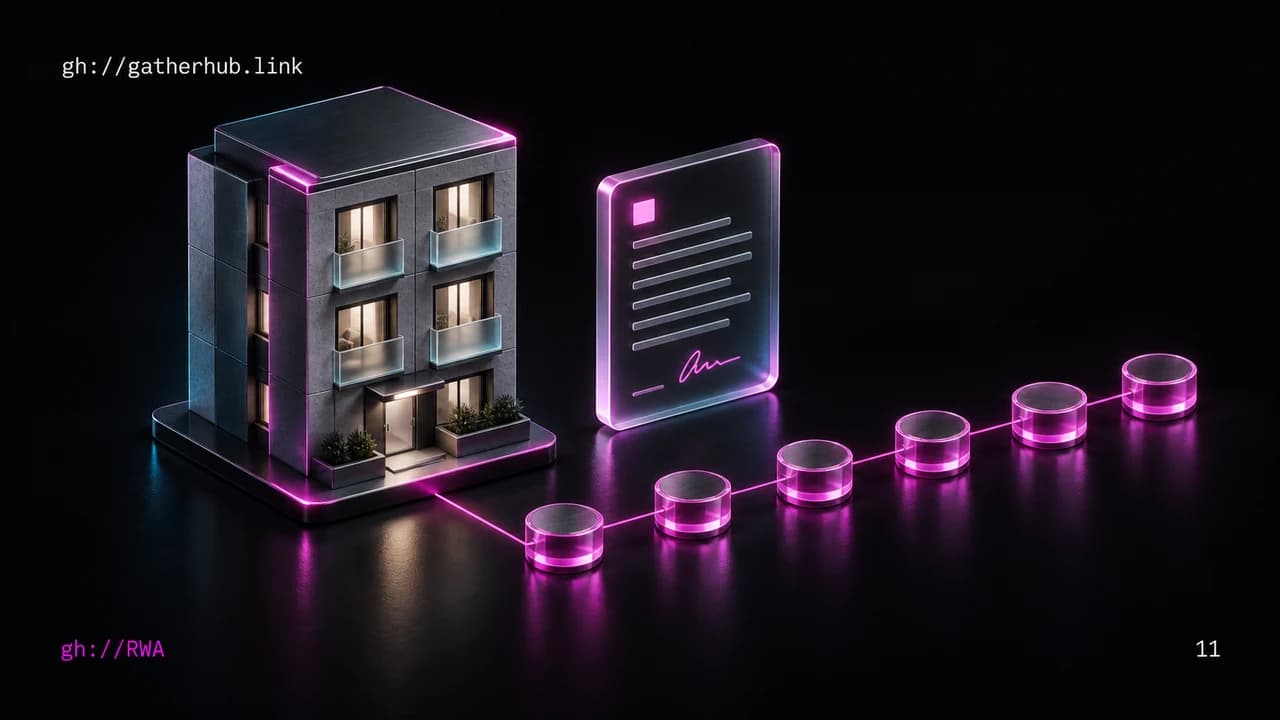
To understand a tokenised building, follow a fictional project from start to finish. Every amount and rule below is invented to explain the mechanism. This is neither an offer nor a return forecast.
You have learned how to identify token rights. Now follow the property, documents and money separately.
1. A structure holds the building
In our scenario, a dedicated company buys a small building for €900,000. It budgets another €100,000 for acquisition costs and a maintenance reserve. Total funding is €1,000,000, with no borrowing to keep the exercise simple.
A dedicated company is a structure created for this transaction. Its existence alone does not prove that every risk is isolated: its commitments and organisation would need examination. A token does not verify the title, building condition or insurance.
2. Rights are defined before issuance
Assume the documents and applicable law allow 10,000 equal interests to be represented by 10,000 tokens. Each corresponds to 1/10,000 of the documented rights and is issued at €100.
This is a teaching assumption. A real project requires checking whether the token represents an equity interest, debt claim or another right. The AMF highlights this distinction for property offers.
Holding 100 tokens represents 1% of the issued interests here. It does not provide the keys to a particular flat: the company owns the building in our example.
3. Rent becomes a flow to distribute
Suppose the company collects €60,000 in annual rent and pays €20,000 in expenses, management and other costs included in the exercise. That leaves €40,000 before tax and a distribution decision.
If the rules allow the entire amount to be distributed equally, each token receives €4, or €400 for 100 tokens. This is arithmetic, not a promise: €60,000 minus €20,000, then €40,000 divided by 10,000.
Distribution may require a decision, identity checks, bank transfers and conversion into payment tokens. A smart contract does not replace actually collecting the rent.
4. An unexpected event changes the result
The following year, imagine only €45,000 collected and €35,000 in costs, including repairs. Our simplified calculation leaves €10,000, or €1 per token if fully distributed under the same conditions.
The token count has not changed, but income has fallen. If expenses exceed receipts, there may be nothing to distribute and the reserve may shrink.
Distinguish advertised rent, collected rent, the result after costs and the amount actually distributed. A promotional percentage can obscure these differences.
5. Exiting is another operation
A holder may seek a buyer for tokens if the rules allow this. Alternatively, they may wait for the building to be sold and proceeds allocated under the documents. These routes have different timelines and potentially different prices.
The BIS discusses economic and legal constraints on tokenisation. Dividing an issuance does not automatically create an active market.
Check your understanding
In the first year, do 100 tokens receive 1% of the €60,000 gross rent? Not under our assumptions. The distribution uses €40,000 after the example’s costs, giving €400 before any tax applicable to the holder.
Remember: the token tracks rights; returns depend on the building’s actual operation and distribution rules.